
La Mirada, CA & San Francisco, CA — March 12, 2026 — The Corporation for Education Network Initiatives in California (CENIC) is pleased to announce that David Lassner, President Emeritus of the University of Hawai’i (UH), and his team will be recognized with the CENIC 2026 Innovations in Networking Award for Network Partner. The award will be presented at CENIC’s biennial conference “The Right Connection” to be held from March 31–April 1, 2026 in Monterey, CA.
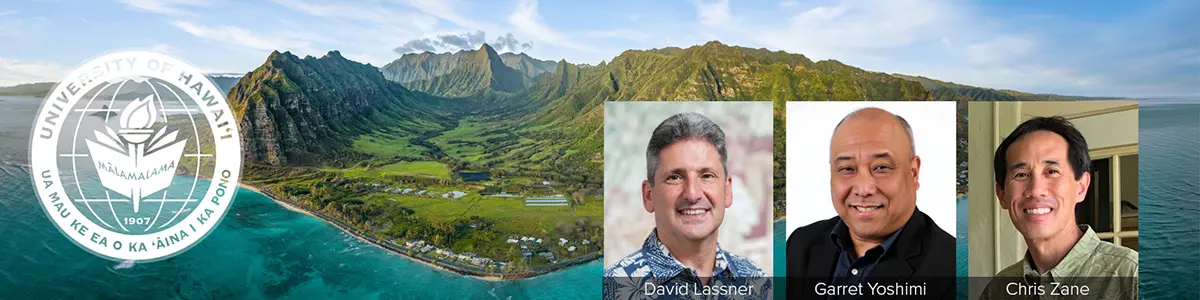
Under President Emeritus David Lassner, along with Garret Yoshimi and Chris Zane, UH’s leadership in international networking stretches back over 35 years. In 1989, UH’s partnership with NASA enabled the first international Internet connection to Australia, linking the University of Melbourne to the global research network via Hawai’i—a foundational moment that established the pattern of trans-Pacific collaboration that continues today. Through the Pacific Communications Network (PACCOM) project in the late 1980s and early 1990s, UH was instrumental in establishing the first academic and research Internet connections to New Zealand, Australia, Japan, Korea, and Hong Kong.
Building on this legacy, NSF’s initial International Research Network Connections (IRNC) TransLight/PacificWave award in 2005 to the University of Southern California launched a new era of high-capacity international networking, with the University of Hawai’i as a key supporting partner alongside the Corporation for Education Network Initiatives in California (CENIC) and the Pacific Northwest Gigapop. This award supported the development of Pacific Wave as a distributed exchange facility and enabled the termination of Australian research and education network AARNet’s SX-Transport links connecting Australia to Seattle and Los Angeles via Hawai’i—the first 10 Gbps submarine fiber connections across the Pacific for research and education.
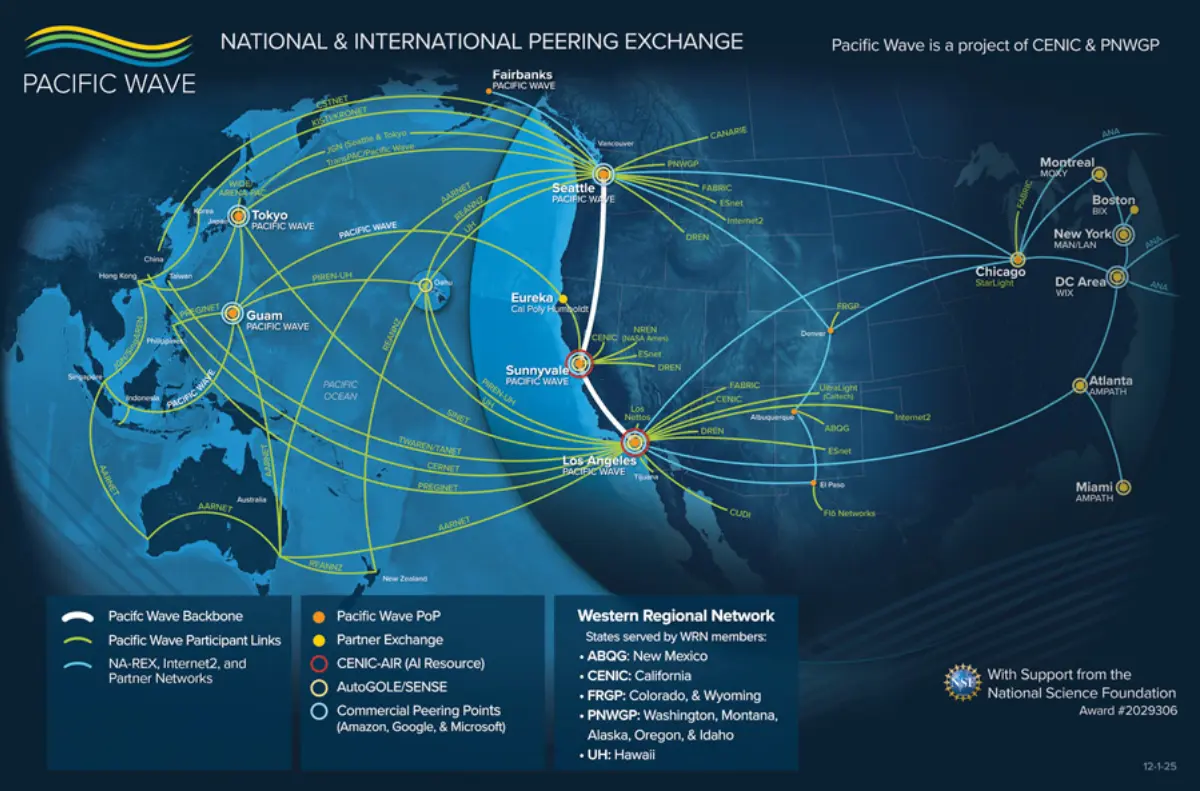
Under David’s leadership as Principal Investigator, the 2010-2015 TransLight/Pacific Wave award transformed this infrastructure into a unified distributed exchange service supporting more than 15 international R&E links serving scores of countries. This project enabled connectivity to the world’s premier astronomical observatories on Mauna Kea and Haleakalā—representing over $1 billion in international scientific investment. The value of these connections to fundamental science cannot be overstated: observations made at the W. M. Keck Observatory contributed directly to two Nobel Prizes in Physics, including the 2011 prize awarded to Saul Perlmutter, Brian Schmidt, and Adam Riess for the discovery of the accelerating expansion of the universe driven by dark energy, and the 2020 prize awarded to Roger Pensore, Reinhard Gensel, and Andrea Ghez for proving the existence of a supermassive black hole at the center of our Milky Way galaxy.
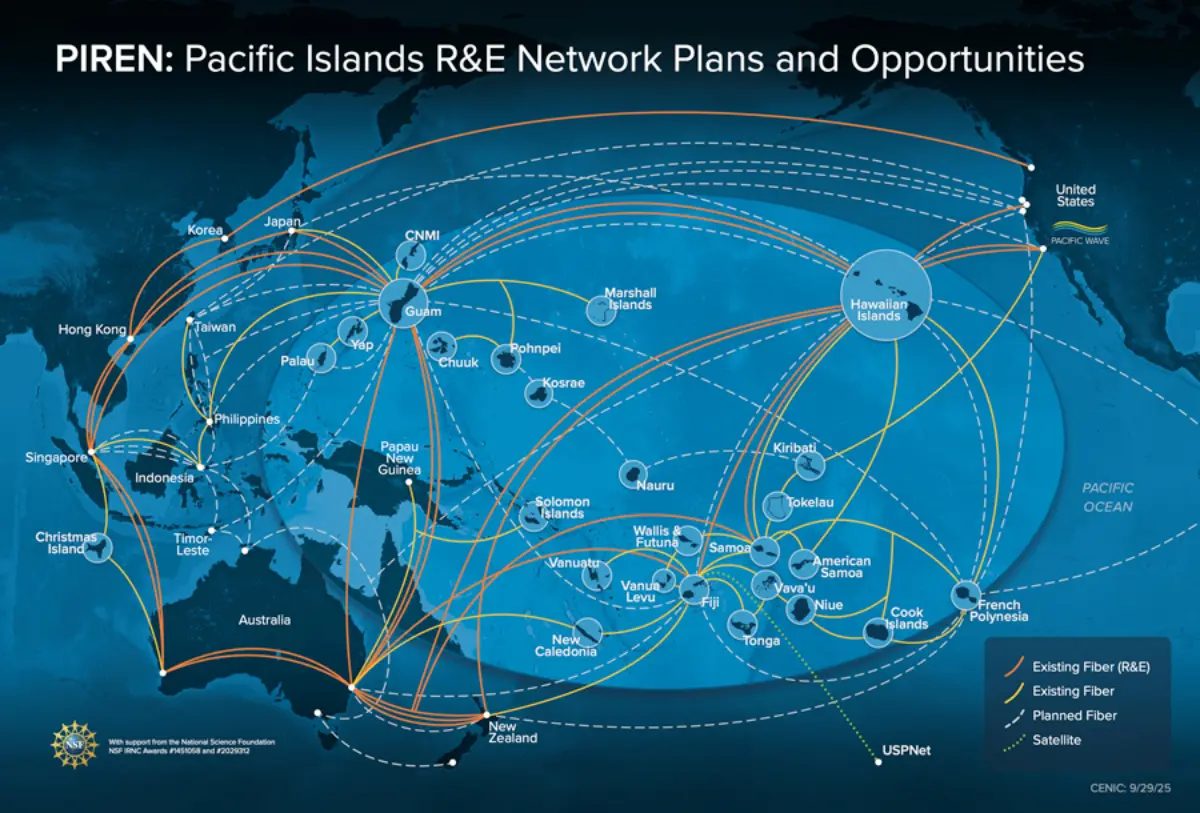
The subsequent Pacific Islands Research and Education Network (PIREN) awards in 2015 and 2020 further demonstrated UH’s vision for Pacific connectivity. Under this leadership, network capacity increased from dual 40 Gbps to multiple 100 Gbps links. Most significantly, the UH team’s vision for extending R&E networking to the Pacific Islands led to the establishment of the Guam Open Research and Education eXchange (GOREX) in 2018, creating a strategic hub that now interconnects submarine cable systems from the United States, Asia, and Australia. As Garret Yoshimi, UH CIO, noted when the Guam-Singapore link was activated in 2021, “this connectivity gives GOREX direct and resilient connections in every direction.”
Beyond the technical achievements, the UH team’s work reflects deep personal commitments to the Pacific Islands and their communities. The islands scattered across Oceania, on the front lines of climate change and rising sea levels, and long underserved by telecommunications, represent the intersection of a technical challenge with the team’s personal missions. Their vision for PIREN has always been about more than bandwidth; it’s about ensuring that island communities have the same access to global research and education resources as their mainland counterparts. Also it is no coincidence that David Lassner has sailed aboard Hōkūleʻa’s Worldwide Voyage; like the traditional navigators who connected Pacific peoples across vast ocean distances using stars and currents, he has worked to connect them through fiber and light, ensuring that these remote island communities are not left beyond the reach of the global research and education network. In 2016, Lassner said, “To me, that’s what the World Wide Voyage and mālama honua stand for—sustainability, indigenous serving, education, research and our service to the community. So I ask, ‘Why wouldn’t we be involved?’ It’s an incredible opportunity to do exactly what the University of Hawaiʻi is supposed to be doing.”
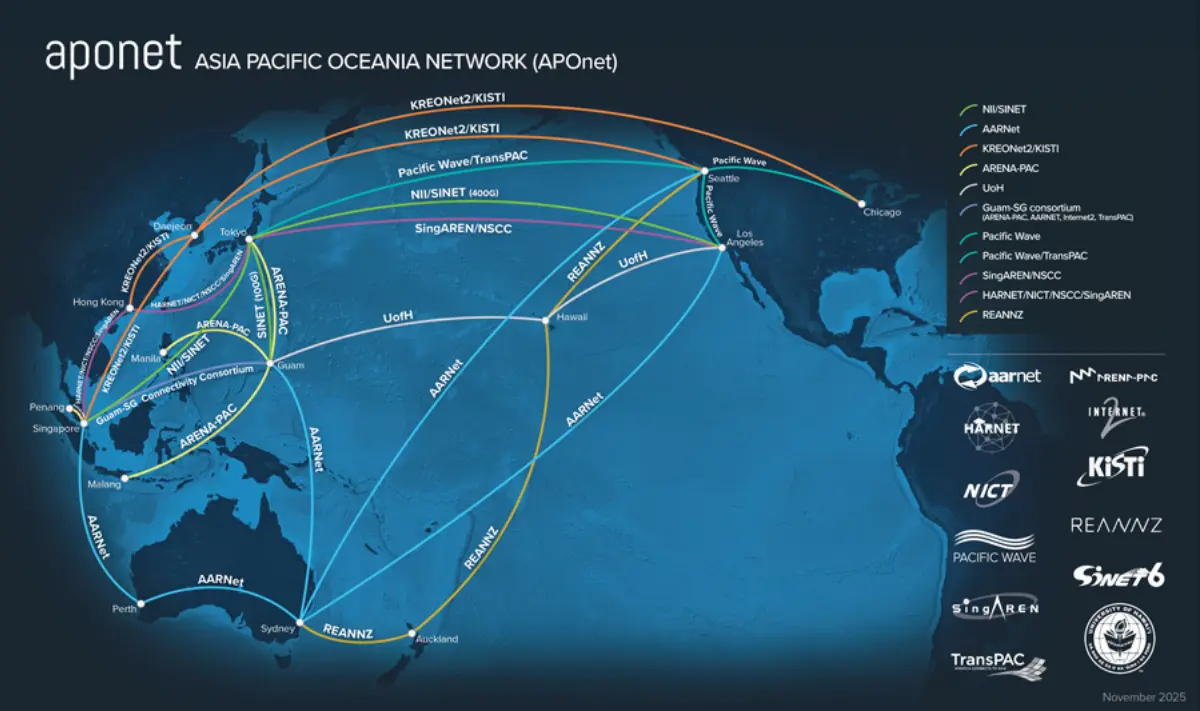
The UH team’s work over the past decades characterizes the core attributes of what an excellent partner is in the world of networking. Working seamlessly with APOnet, GOREX, USPNet, PIREN, AARNET, REANNZ, and Pacific Wave, their creativity in addressing challenges and working for solutions has enabled important connectivity throughout Oceania and Pacific Rim nations; and their seamless support through various partnership structures over our CENIC’s decades of collaboration is a tribute to the excellence of the University of Hawai’i as a key partner in this important work.
“The University of Hawai’i’s geographic position in the middle of the Pacific is only part of the story; what truly makes today’s Pacific Wave connectivity possible is the people,” said Jonah Keough, Managing Director of the Pacific Wave, a nearly 30-year partnership between CENIC and the Pacific Northwest Gigapop. “David, Garret, and Chris understand that networks are built on relationships as much as fiber, and they’ve been architects of the collaborations that connect researchers across the Pacific Rim. Congratulations on this well-deserved recognition.”
The UH team was early to recognize the importance of human networks as being as critical as high-tech broadband network connections. This recognition of the importance of people forging smart relationships has enabled shared and collaborative networks that connect throughout Oceania and the Pacific Rim, advancing research in astronomy, oceanography, coral reef science, high-energy physics, and the environment over more than three decades.
Their work over these past decades characterizes the core attributes of what an excellent partner is in the world of networking. Working seamlessly with APOnet, the Guam Open R&E Network, or GOREX, USPNet, PIREN, AARNET, REANNZ, and Pacific Wave, the creativity of David, Garret, and Chris in addressing challenges and working for solutions has enabled important connectivity throughout Oceania and Pacific Rim nations to the benefit of the global research community.
UC San Diego’s GAIA Initiative Promises Transformation of Atmospheric and Climate Research
CENIC Members Doing the Impossible in Weather and Climate Forecasting with AI and Advanced Networks
Reimagining Supercomputing with the Distributed Bring-Your-Own-Resources Model
The CENIC AI Resource Powers Diverse Disciplines at CENIC Member Campuses
Celebrating Dr. Ben Izadi’s Leading Role in the CENIC and Cypress College Student Internship Program
Stay up to date on news and stories from the CENIC community.